Planer Machines: Working Principle and Key Benefits
leadermachinetools on 16 February, 2026 | No Comments
Founded in 1971 by the visionary Sh. Darshan Lal Sehdev, Leaders Machine Tools has grown from a small casting unit into one of India’s most trusted machine tool manufacturers. From Batala, Punjab — a city known for engineering excellence — we manufacture heavy-duty lathes, milling machines, VTLs, Plano Millers, and custom workshop solutions.
In recognition of his contribution to Indian industry, Sh. Darshan Lal Sehdev was awarded the prestigious Udyog Patra Award, presented by Sh. M. Hidayatullah, then Vice President of India, on 20 December 1980 at FICCI Auditorium, New Delhi.
As part of our commitment to Indian manufacturing, we produce robust, high-accuracy Planer Machines designed for large surface machining, heavy components, and precision finishing.
What Is a Planer Machine?
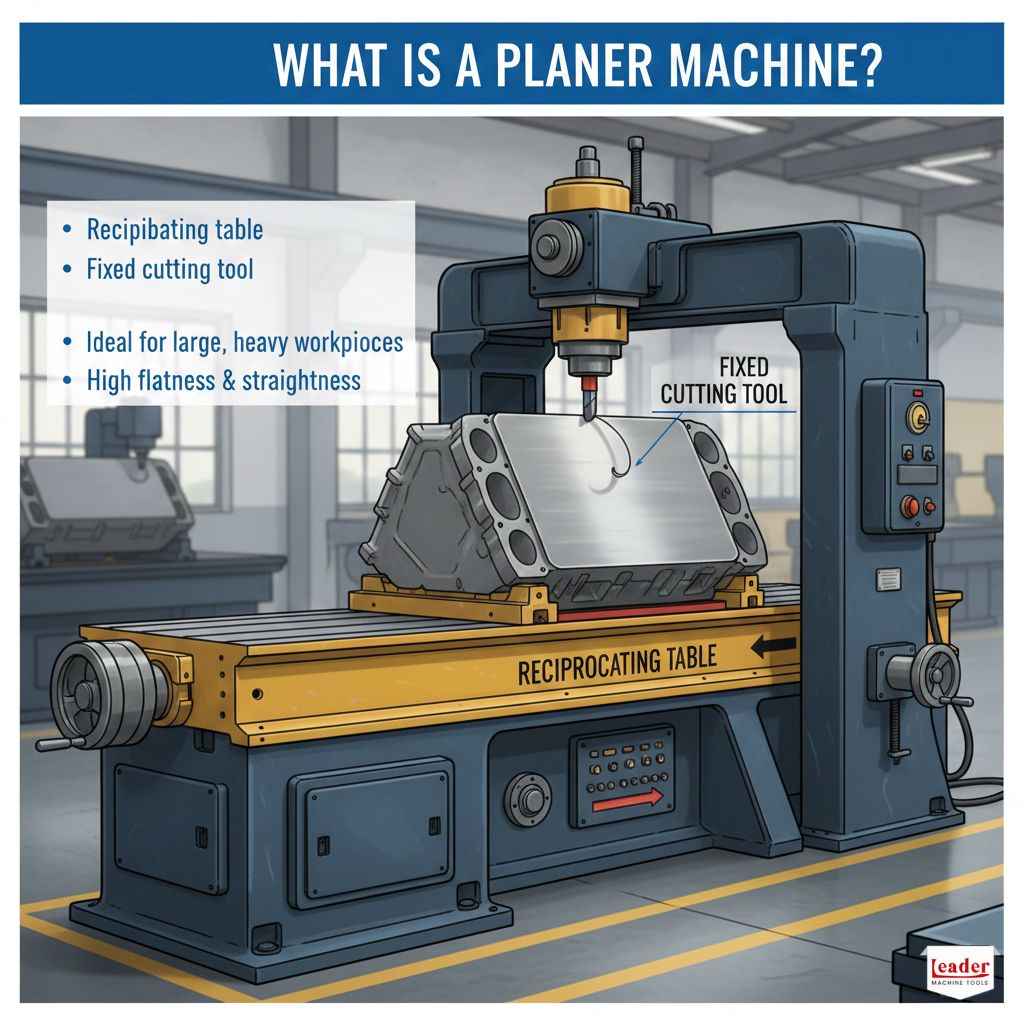
A Planer Machine is a heavy-duty metal cutting machine used to produce perfectly flat, smooth, and accurate surfaces on large workpieces.
Unlike milling machines where the cutter moves, in a planer the workpiece moves on a long reciprocating table, while the cutting tool stays stationary.
This makes planer machines ideal for:
- Long, heavy components
- Large castings
- Steel fabrication parts
- Precision base plates
- Machine beds and frames
At Leaders Machine Tools, our planer machines are built with a rigid structure, wide working table, powerful drive system, and smooth feed mechanism, ensuring accuracy over long working lengths.
How Planer Machines Work (Step-by-Step)
A planer machine follows a simple but highly controlled machining process:
1. Workpiece Clamping
The job is securely clamped on the long reciprocating table using T-slots, heavy clamps, and bolts.
(Strong clamping ensures vibration-free cutting.)
2. Table Reciprocation
The table moves back and forth in a straight line.
This movement carries the workpiece under the fixed cutting tool.
3. Tool Engagement
As the table moves forward, the tool cuts the material.
During the return stroke, the tool automatically lifts slightly to avoid contact.
4. Cross & Vertical Feed
Tool heads can move:
- Crosswise (side-to-side)
- Vertically (up-down)
This allows machining of wide surfaces, edges, slots, and steps.
5. Multi-Tool Operation
Heavy planer machines have multiple tool heads, enabling:
- Simultaneous cutting
- Faster material removal
- Better accuracy
6. Final Finishing
After roughing, lighter finishing passes produce a smooth, uniform surface within close tolerances.
Leaders Machine Tools ensures every planer machine is designed for steady motion, precise alignment, and long-term accuracy — even under heavy industrial loads.
Advantages in Large Surface Finishing
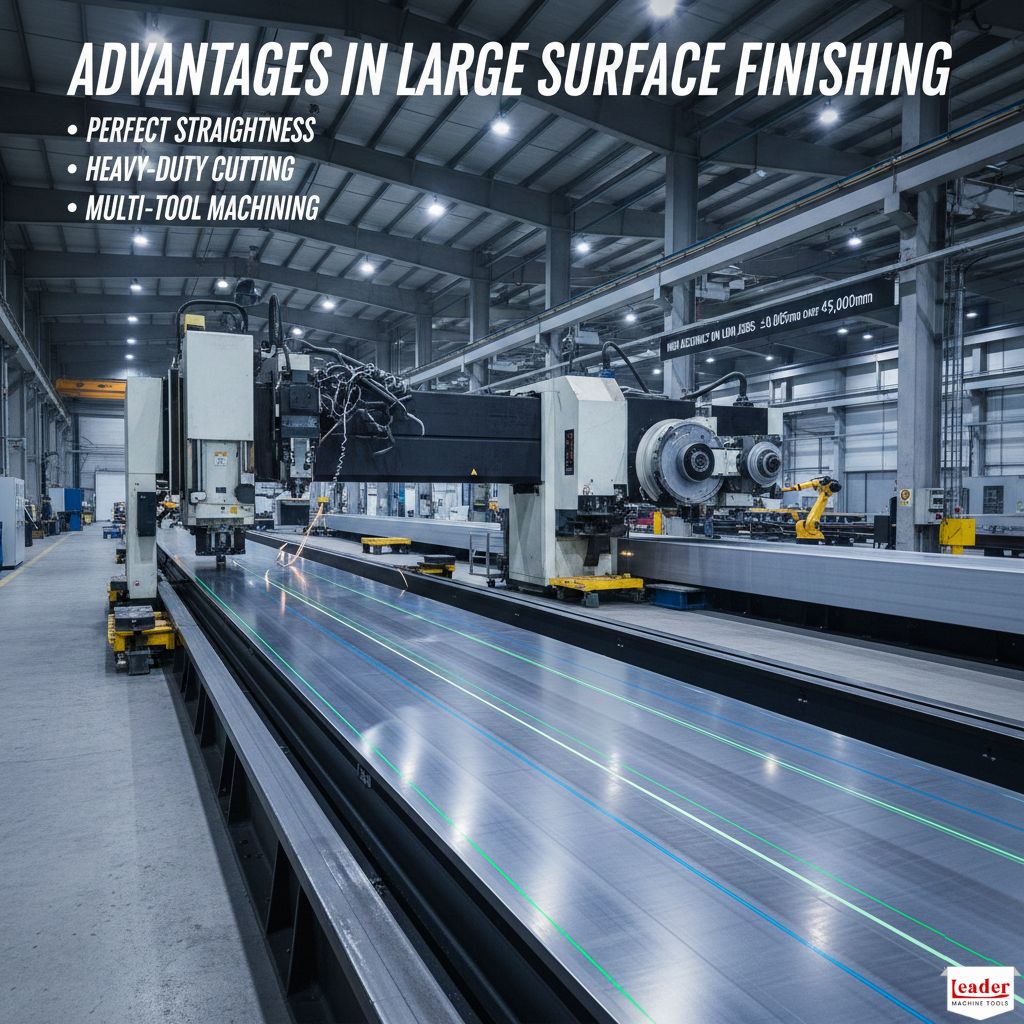
Planer machines offer several unmatched benefits, especially for large and oversized components:
1. Excellent Straightness & Flatness
Planer machines are ideal for machining long surfaces where parallelism and straightness are mandatory — such as machine beds, frames, or base plates.
2. High Accuracy Over Large Areas
Due to rigid construction and smooth feed control, planer machines maintain accuracy even when machining very long workpieces.
3. Heavy-Duty Metal Removal
The powerful drive system and stable design allow for heavy cutting depths on cast iron, steel, and fabricated parts.
4. Perfect for Oversized Jobs
CNC milling machines have size limitations, but a planer can handle:
- Extra-long components
- Large castings
- Wide plates
This makes planers extremely useful in heavy engineering industries.
5. Multi-Tool Productivity
With multiple tool heads, roughing and finishing can happen together, reducing total machining time.
6. Long Machine Life
Planer machines are known for durability.
With basic care, they perform reliably for decades — a reason they remain popular in workshops across India.
Applications Across Industries
Planer machines are widely used in industries that handle large or heavy components.
Typical users include:
1. Heavy Engineering & Fabrication
Machining of long beams, frames, and structures.
2. Machine Tool Manufacturing
Planing of lathe beds, milling machine bodies, and precision guideways.
3. Steel & Rolling Mills
Machining of base plates, housings, and heavy mill components.
4. Railways & Transport
Precision machining of wagon parts, bogie frames, coupler plates, etc.
5. Power Plants
Machining of turbine casings, pump bases, and large support plates.
6. Mining & Earthmoving Equipment
Large structural components made of steel or cast iron.
Leaders Machine Tools supplies robust machines to workshops, plants, PSUs, fabrication units, and engineering companies across India.