Planer Machine vs Plano Miller: Which One Is Right for You?
leadermachinetools on 17 February, 2026 | No Comments
Selecting the right heavy-duty machining solution is a big decision for any workshop. Both Planer Machines and Plano Millers are designed for large components, heavy metal removal, and long workpieces — but they serve different purposes. Choosing the wrong machine can affect accuracy, power consumption, project timelines, and running costs.
At Leaders Machine Tools, we have been guiding Indian industries since 1971. With more than five decades of manufacturing experience and deep expertise in heavy engineering, we help customers select machines that fit their production, accuracy, and budget needs perfectly.
Before you invest, here is a clear, practical comparison.
Working Concept of Both Machines
How a Planer Machine Works
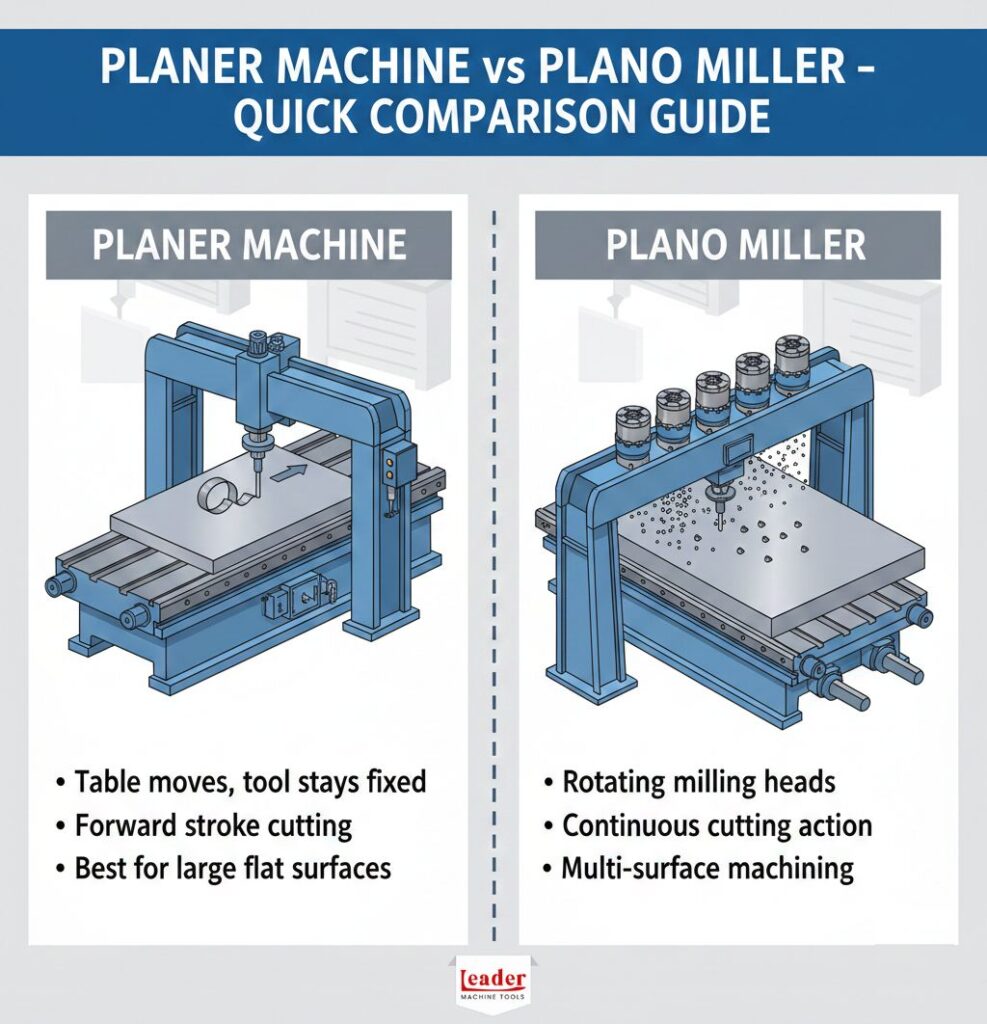
A Planer Machine performs machining by moving the workpiece under a stationary cutting tool.
- The workpiece is fixed on a large table.
- The table performs a long forward and return stroke.
- Cutting happens during the forward stroke only.
- Tools are fixed on a tool head or cross-rail.
Best suitable for:
Large, heavy jobs requiring straight, flat, or contour surfaces.
How a Plano Miller Works
A Plano Miller (Plano Milling Machine):
- Uses multiple milling heads
- Has a table movement similar to a planer
- But performs milling operations while tools rotate
This gives higher metal removal rate, better finish, and the ability to machine multiple surfaces simultaneously.
Best suitable for:
High-accuracy milling, slotting, square machining, T-slots, and heavy machining with high productivity.
Key Structural Differences
Both machines look similar from the outside — a big table, strong columns, and cross-rail. But internally, they differ in:
1. Cutting Action
- Planer: Linear motion of the table, fixed cutting tool
- Plano Miller: Rotating milling cutters + linear table movement
2. Tool Holding
- Planer: Single/dual tool heads
- Plano Miller: Multiple milling heads (vertical, horizontal, side heads)
3. Accuracy & Finish
- Planer: Good accuracy, moderate finish
- Plano Miller: High accuracy + superior finish
4. Productivity
- Planer: Slower due to single stroke cutting
- Plano Miller: Faster because of continuous tool rotation + multi-head cutting
5. Capability
- Planer: Heavy straight cuts, long flat surfaces
- Plano Miller: Advanced milling such as slots, pockets, grooves, angles, and precision surfaces
Use Case Comparison (Surface Type, Part Size, Power)
1. Surface Type
| Requirement | Best Choice | Reason |
|---|---|---|
| Straight flat surfaces | Planer | Strong, deep metal removal |
| T-slots & keyways | Plano Miller | Rotating cutters needed |
| Square & parallel machining | Plano Miller | Multi-head precision |
| Very heavy roughing | Planer | High structural rigidity |
2. Part Size
Both machines handle large workpieces, but:
- Planer: Ideal for long beds, long plates, heavy blocks, and cast iron pieces
- Plano Miller: Ideal for components requiring precise parallelism and multiple machining operations at once
3. Power Usage
- Planer: Higher power consumption because the full table mass moves every stroke
- Plano Miller: More efficient due to continuous cutting and less idle motion
If power cost matters, Plano Miller becomes a better long-term investment.
Cost, Space, and Maintenance Overview
Machine Cost
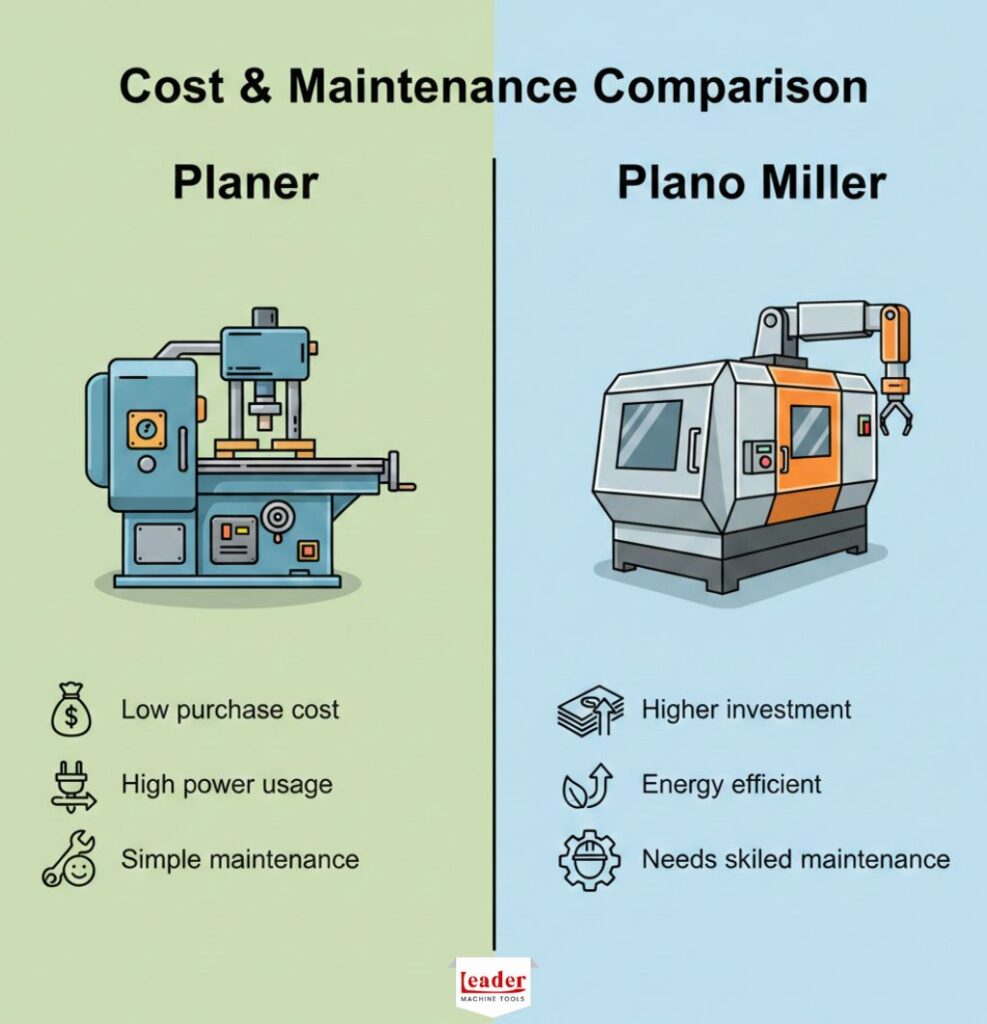
- Planer Machine: Lower initial cost
- Plano Miller: Higher investment due to rotating heads, gearbox system, and precision assemblies
Land & Space
Both occupy large floor space, but Plano Millers often require slightly higher vertical clearance due to spindle head assemblies.
Maintenance
- Planer: Simple mechanism → Easier & cheaper to maintain
- Plano Miller: More moving parts → Skilled maintenance needed
Running Cost
- Planer: Higher electricity cost due to reciprocating table
- Plano Miller: Energy-efficient, more output per hour
Which Machine Fits Your Industry?
Choose a Planer Machine if your work involves:
- Large steel plates
- Machine beds
- Structural fabrication
- Block machining
- Roughing heavy castings
- Straightening and flattening tasks
Planers are preferred in heavy engineering industries where brute metal removal is more important than precision milling.
Choose a Plano Miller if your work demands:
- High accuracy
- Multi-surface machining
- T-slots & grooves
- Precision flatness
- High productivity
- Continuous production workloads
Industries like tool rooms, steel plants, energy sector, heavy machine shops, and OEM component manufacturers benefit the most from Plano Millers.
Why Leaders Machine Tools?
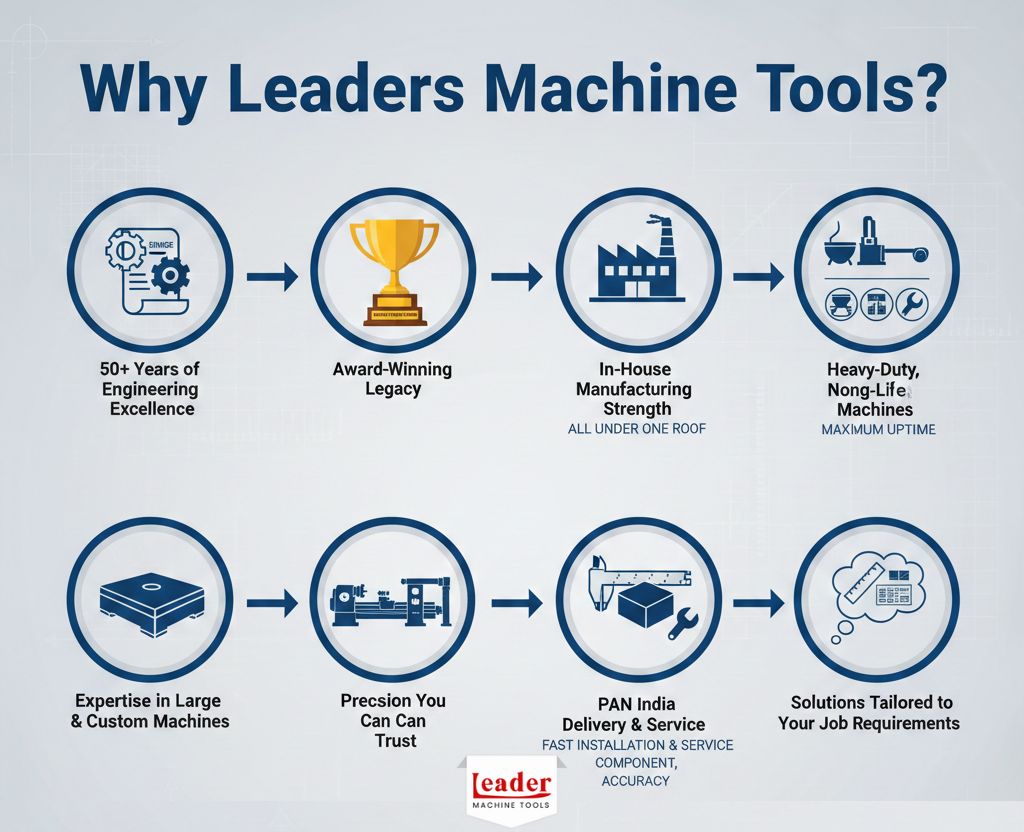
Founded in 1971 by Sh. Darshan Lal Sehdev, Leaders Machine Tools has grown from a small casting unit to one of India’s most trusted heavy-duty machine tool manufacturers. Our long journey, backed by engineering excellence from Batala, has helped thousands of machine shops improve performance and productivity.
The prestigious Udyog Patra Award, presented by India’s then Vice President Sh. M. Hidayatullah in 1980, stands as a testimony to our commitment to Indian manufacturing.
Whether you need a Planer Machine or a Plano Miller, our team helps you choose the right machine based on:
- Job size
- Material
- Required accuracy
- Production rate
- Budget
- Floor space availability
CTA: Compare Planer and Plano Milling Machines
Still not sure which machine fits your workshop?
Our experts at Leaders Machine Tools can analyse your components and recommend the perfect machine for your workload.
Contact us today to compare Planer and Plano Milling Machines and get a personalised recommendation.