How to Improve Accuracy in Milling Operations
leadermachinetools on 16 February, 2026 | No Comments
Accurate milling is the backbone of every machining workshop. Whether you are producing precision components, maintaining tool-room parts, or handling heavy-duty industrial jobs, accuracy decides the quality of your final outcome. Even a small error in measurement or alignment can lead to rework, rejection, material wastage, and higher production costs.
At Leaders Machine Tools, we understand how important accuracy is for every machinist and workshop owner. Since 1971, we have been manufacturing reliable, heavy-duty, and precision-focused milling machines in Batala, Punjab. Our decades of engineering experience help Indian industries achieve stable, repeatable, and long-term accuracy in their daily machining operations.
This guide explains the practical steps you can follow to improve accuracy in milling — whether you are working on a vertical milling machine, universal milling machine, or a CNC system.
Machine Setup & Calibration
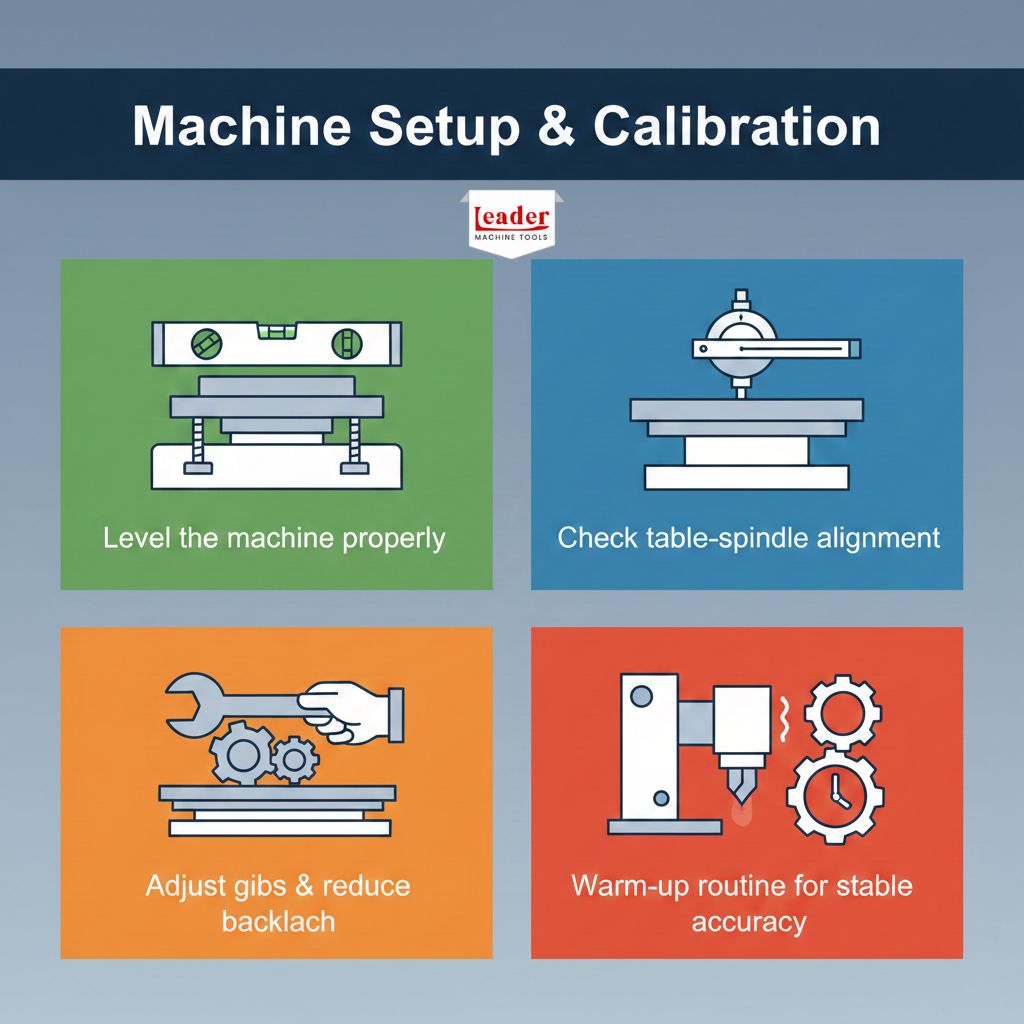
One of the biggest reasons behind accuracy loss in milling is improper machine setup. Even the best machine delivers poor results if the base alignment and calibration are ignored.
1. Ensure Proper Leveling
A machine must stand on a solid, vibration-free foundation.
- Use a precision spirit level
- Check leveling in both X and Y directions
- Recheck after machine warm-up
A leveled machine eliminates vibration and prevents taper or uneven cutting.
2. Align the Table and Spindle
Misalignment between table and spindle leads to dimensional errors.
- Check spindle runout
- Verify table flatness
- Inspect column-to-table squareness
Regular alignment ensures consistent results, especially in multi-pass operations.
3. Tighten Gibs & Check Backlash
Loose machine gibs cause backlash and unwanted play in movement.
- Adjust gibs for smooth but firm movement
- Measure backlash using dial indicators
- Compensate backlash during finishing passes
This helps achieve repeatable accuracy during precision milling.
4. Warm-Up Routine
Before starting the job:
- Run spindle at low RPM for 5–10 minutes
- Move all axes through full travel
This stabilizes the machine thermally and reduces early-stage inaccuracies.
Choosing the Right Cutting Tools
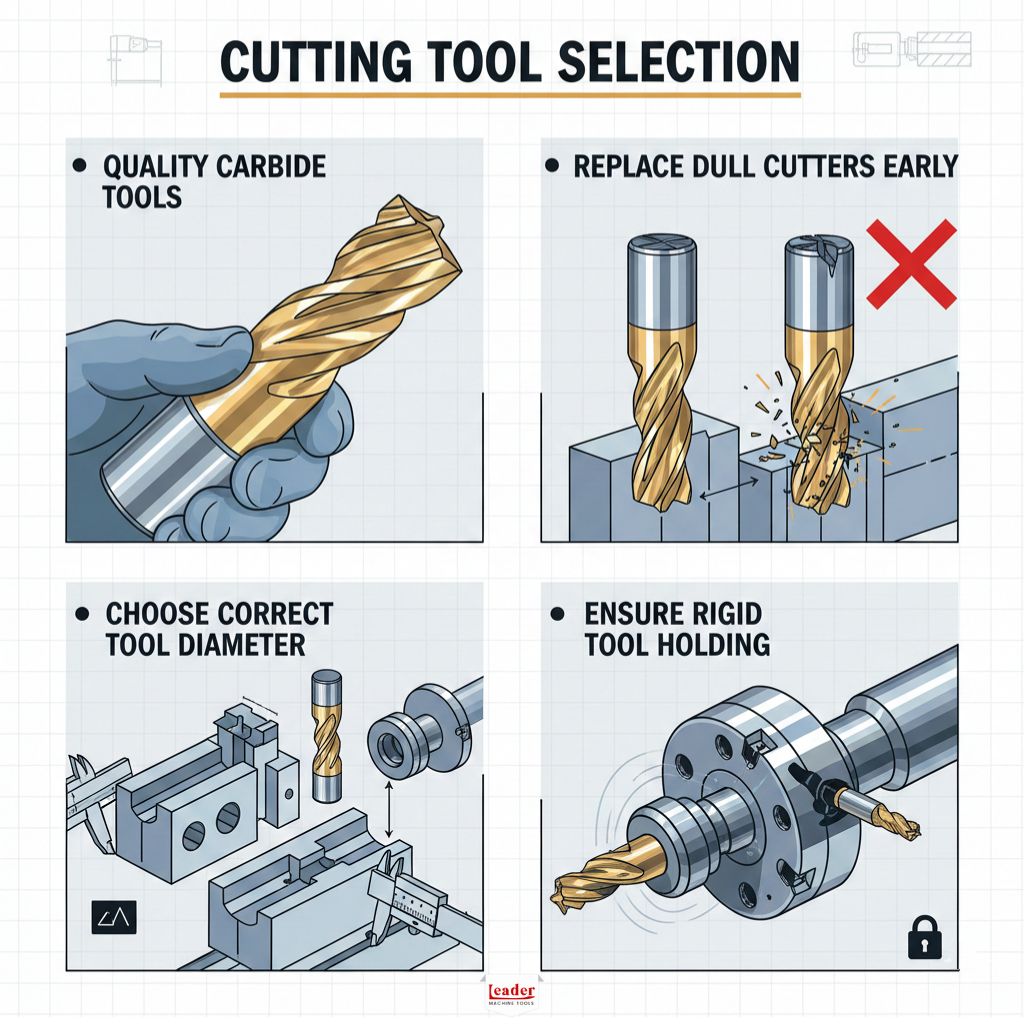
Tooling has a direct impact on surface finish, dimensional accuracy, and overall performance.
1. Use Quality Tools With Correct Geometry
Carbide tools with proper rake angle and coating (TiN, TiAlN) reduce friction and improve life.
Right tool geometry ensures cleaner cuts and minimal deflection.
2. Avoid Overused or Dull Tools
A dull cutter increases heat and vibration, causing dimensional errors.
Replace or re-sharpen tools before accuracy issues appear.
3. Match Tool Diameter With Job Requirement
Using an unnecessarily large cutter increases load, while a very small cutter may deflect easily.
Choose tool size based on material hardness and required precision.
4. Choose the Right Tool Holder
Collet chucks, end mill holders, and BT tapers must be clean, balanced, and rigid.
Poor clamping leads to tool runout and affects tolerance control.\
Feed Rate and RPM Optimization
Cutting parameters decide how smooth, stable, and precise your milling operation will be.
1. Set the Correct RPM
RPM depends on
- Material (MS, CI, SS, Aluminium)
- Cutter diameter
- Tool material
Use recommended charts for best results.
Too high RPM = heat + tool wear
Too low RPM = rough finish + chatter
2. Maintain Proper Feed Rate
Feed rate should match the chip load requirement.
- Low feed → rubbing, heat, poor finish
- High feed → tool breakage, dimensional error
For finishing cuts, slightly reduce feed for better accuracy.
3. Depth of Cut (DOC) Management
Take heavier cuts in roughing, but always do a light finishing pass.
A controlled finishing pass refines the final size and surface finish.
4. Reduce Chatter With Correct Parameters
If you hear vibration or chatter:
- Reduce RPM
- Tighten tool holder
- Increase rigidity by shortening tool overhang
Regular Maintenance & Lubrication Tips
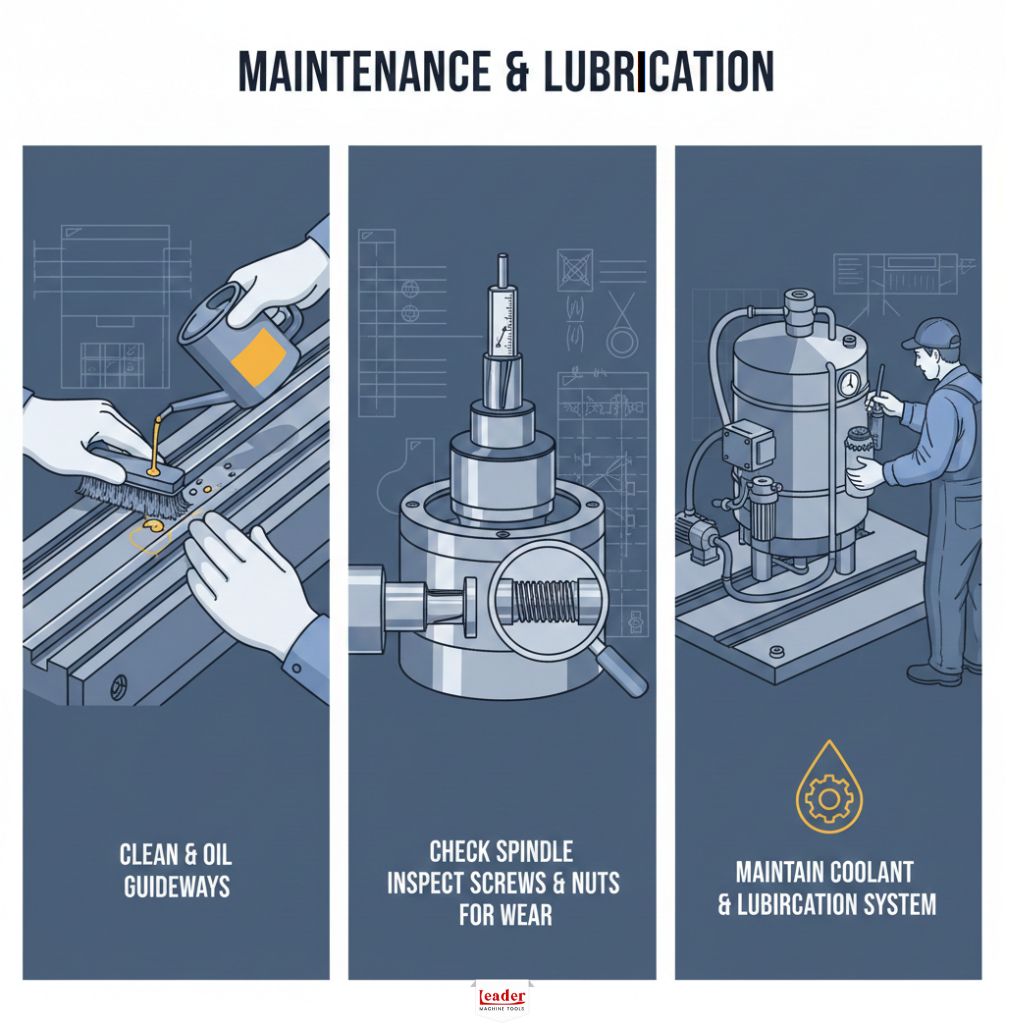
Accuracy depends heavily on how well the machine is maintained.
1. Keep Guideways Clean and Lubricated
Dust, metal chips, or dry surfaces affect movement accuracy.
Ensure regular oiling of:
- Guideways
- Lead screws
- Spindle bearings
- Slide surfaces
2. Check for Wear in Lead Screws and Nuts
Worn screw threads create backlash and cause size variation.
Replace or adjust nuts when backlash increases beyond acceptable limits.
3. Maintain Spindle Health
Spindle should rotate smoothly without noise or heating.
High-quality bearings ensure low runout and stable cutting accuracy.
4. Schedule Periodic Inspection
A monthly and quarterly check helps identify issues early:
- Loose bolts
- Unusual vibration
- Coolant flow problems
- Electrical panel issues
Well-maintained machines deliver stable accuracy for years.
Upgrading to CNC Milling Systems
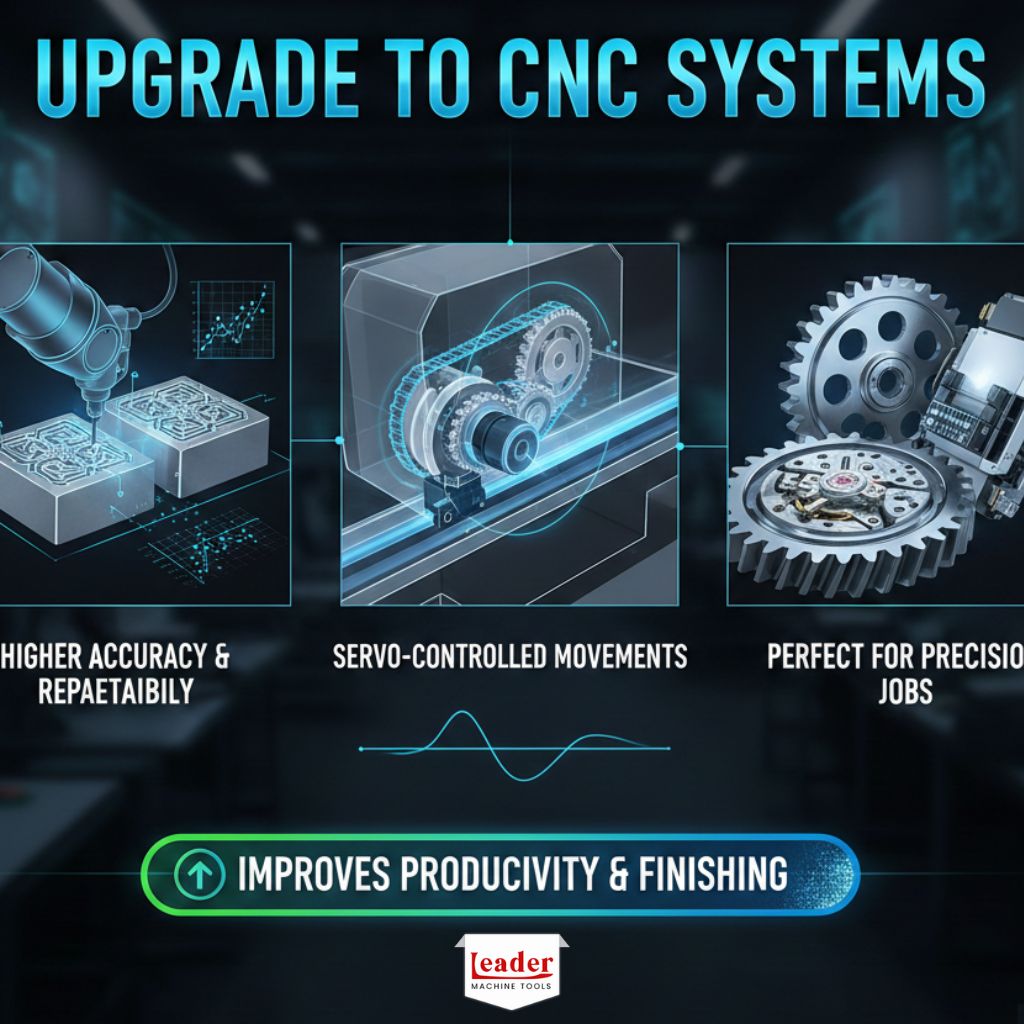
For workshops aiming to improve accuracy, productivity, and repeatability, upgrading to a CNC milling system is a long-term investment.
Why CNC Improves Accuracy?
- Programmed tool paths eliminate manual errors
- Servo controls provide precise movement
- Repeatability is extremely high
- Better finish at higher speeds
- Multi-axis machining becomes possible
Suitable for:
- Precision engineering
- Dies & moulds
- Batch production
- Complex shapes
Leaders Machine Tools Advantage
With five decades of experience, our milling machines are designed with:
- Heavy-duty cast iron structure for stability
- Hardened and ground guideways
- Precision spindle assemblies
- Rigid column and table design
- Accurate feed mechanisms
These features make our machines ideal for workshops that want superior accuracy and long-term reliability.
Conclusion
Improving accuracy in milling operations is not about one big change — it is about many small, consistent improvements. Proper machine setup, the right tooling, balanced cutting parameters, and regular maintenance together ensure high-quality machining results.
Indian workshops today demand precision, productivity, and reliability. Leaders Machine Tools, established in 1971, continues to support industries with machines built on engineering strength, heavy-duty design, and dependable accuracy.
CTA
Looking to improve accuracy in your workshop? Contact us for high-precision milling machines designed for stable, accurate and long-life performance.