Difference Between Milling and Planing Operations
leadermachinetools on 17 February, 2026 | No Comments
Understanding the difference between milling and planing is important for workshops, fabrication units, and industries that work with metal components. Both are fundamental machining processes, yet they work in completely different ways and are used for different types of jobs.
This guide explains how each process works, their technical differences, where each one fits best, and the kind of machines used in modern workshops. The content is written especially for Indian industries and students looking for simple, easy-to-understand information.
At Leaders Machine Tools, we have been manufacturing high-precision milling machines and heavy-duty workshop machinery since 1971. Our experience of over five decades, combined with our roots in Batala’s engineering excellence, allows us to provide reliable insights and solutions for all machining needs.
Overview of Each Process
What is Milling?
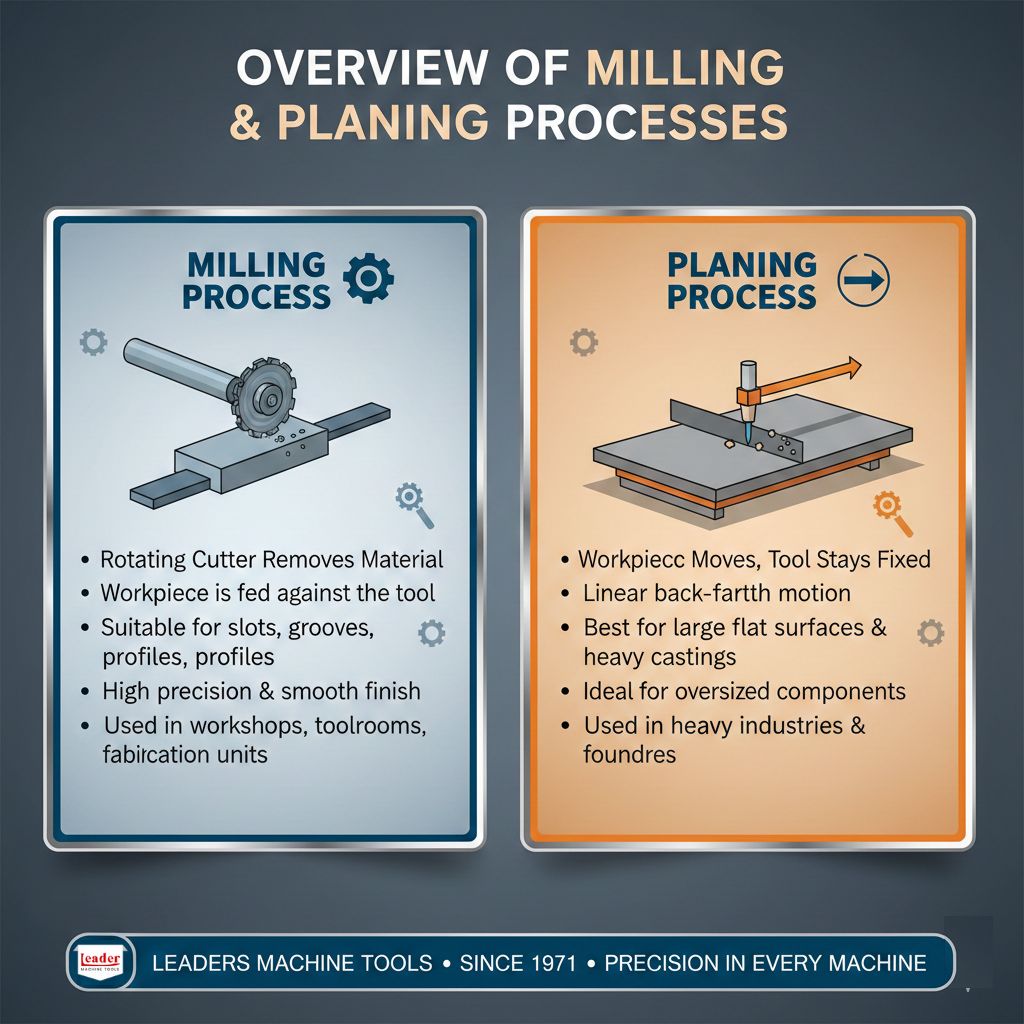
Milling is a machining process where a rotating cutting tool removes material from a stationary or moving workpiece. It is ideal for making slots, grooves, flat surfaces, profiles, and complex shapes.
How it works:
- The cutter rotates at high speed.
- The workpiece is fed against the rotating cutter.
- Multiple types of tooling and attachments can be used.
Milling is known for accuracy, flexibility, and the ability to produce detailed shapes.
What is Planing?
Planing is a machining process used to produce very large flat surfaces on big, heavy, or long workpieces. Unlike milling, here the workpiece moves, and the cutting tool remains stationary.
How it works:
- The workpiece is clamped to a moving table (called the platen).
- The platen moves back and forth in a linear motion.
- A cutting tool removes material during each forward stroke.
Planing is ideal for heavy engineering, large bed surfaces, casting surfaces, and long components.
Key Technical Differences (Table Format)
| Feature / Parameter | Milling | Planing |
|---|---|---|
| Tool Movement | Tool rotates at high RPM | Tool is stationary; workpiece moves in a straight line |
| Workpiece Movement | Fixed or slow feed | Moves back and forth (reciprocating) |
| Surface Type | Flat, curved, contoured | Mostly large flat surfaces |
| Precision Level | Higher precision & repeatability | Moderate precision for large surfaces |
| Best For | Slots, pockets, profiles, complex machining | Long beds, heavy castings, very large surfaces |
| Material Removal Rate | Higher, faster for medium-sized jobs | Slower due to reciprocating motion |
| Machine Structure | Compact, vertical/horizontal/Universal | Large, heavy, floor-mounted planer |
| Flexibility | Very flexible with many attachments | Limited compared to milling |
| Industries | General machining, workshops, toolrooms | Heavy fabrication, casting foundries |
| Automation | Highly automatable (CNC milling) | Mostly manual or semi-automatic |
Advantages of Milling Over Planing
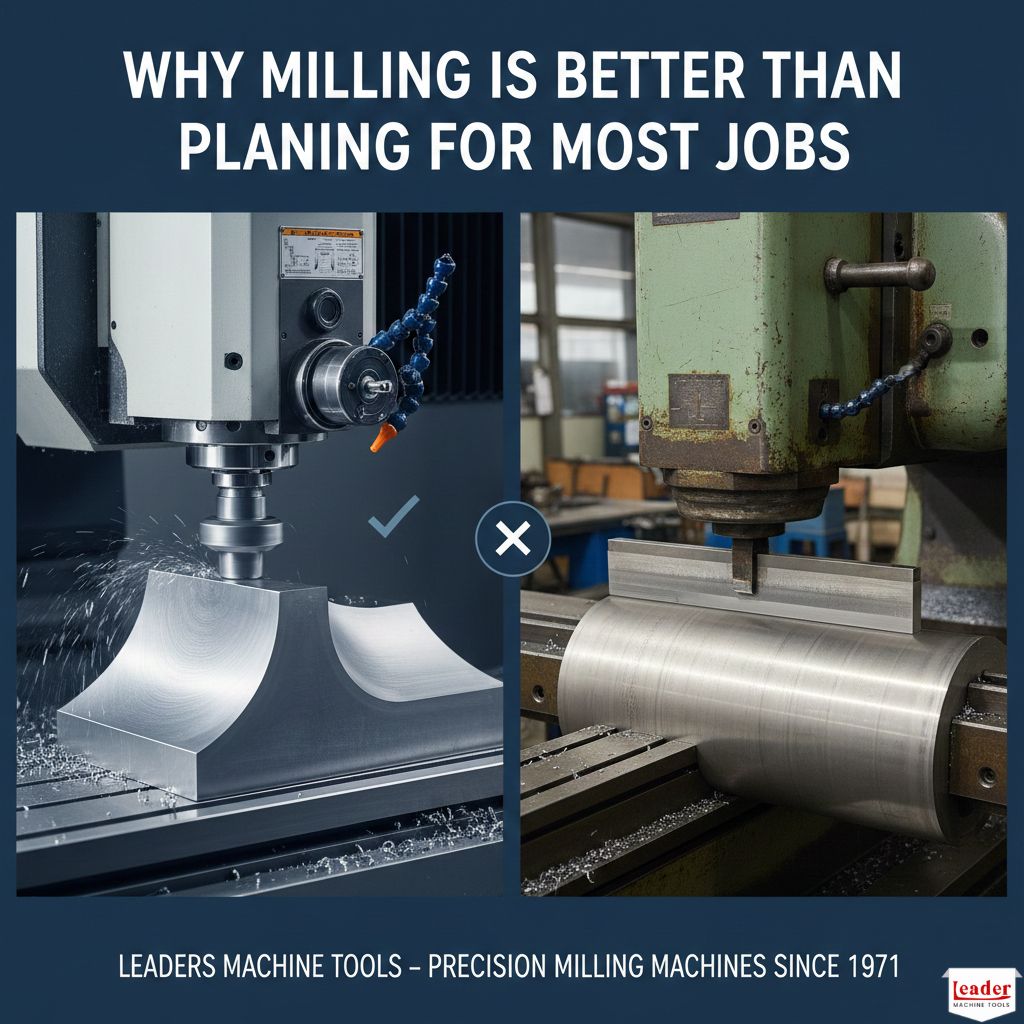
Milling offers several benefits, especially for modern, fast-moving workshops:
1. Higher precision and surface accuracy
Milling machines deliver tighter tolerances and smoother finishes, especially when using quality cutters and coolant systems.
2. Ability to machine complex shapes
Contours, pockets, profiles, slots, and keyways—milling handles tasks that planing simply cannot do.
3. Faster machining for most components
Rotary motion + multiple cutting edges = efficient, quick material removal.
4. Supports modern tooling and automation
CNC milling, carbide cutters, and digital measuring systems have modernised the process significantly.
5. More suitable for small and medium-sized jobs
Planing is not economical unless the component is very large or heavy.
When Planing Is Still Preferred
Even today, planing remains important in many heavy engineering sectors for specific reasons:
1. Machining very large surfaces
Long beds, machine frames, and heavy castings cannot be handled effectively on milling machines.
2. Better for heavy cuts on massive components
Planers are built to remove material from large structures without vibration.
3. Ideal for heavy industries
Steel plants, foundries, power plants, and locomotive workshops still depend on planers for rough machining of big parts.
4. Economical for oversized workpieces
When the component is huge, transporting it to specialized milling machines becomes difficult. Planing solves this problem.
Machines Used for Each Process
Machines Used for Milling
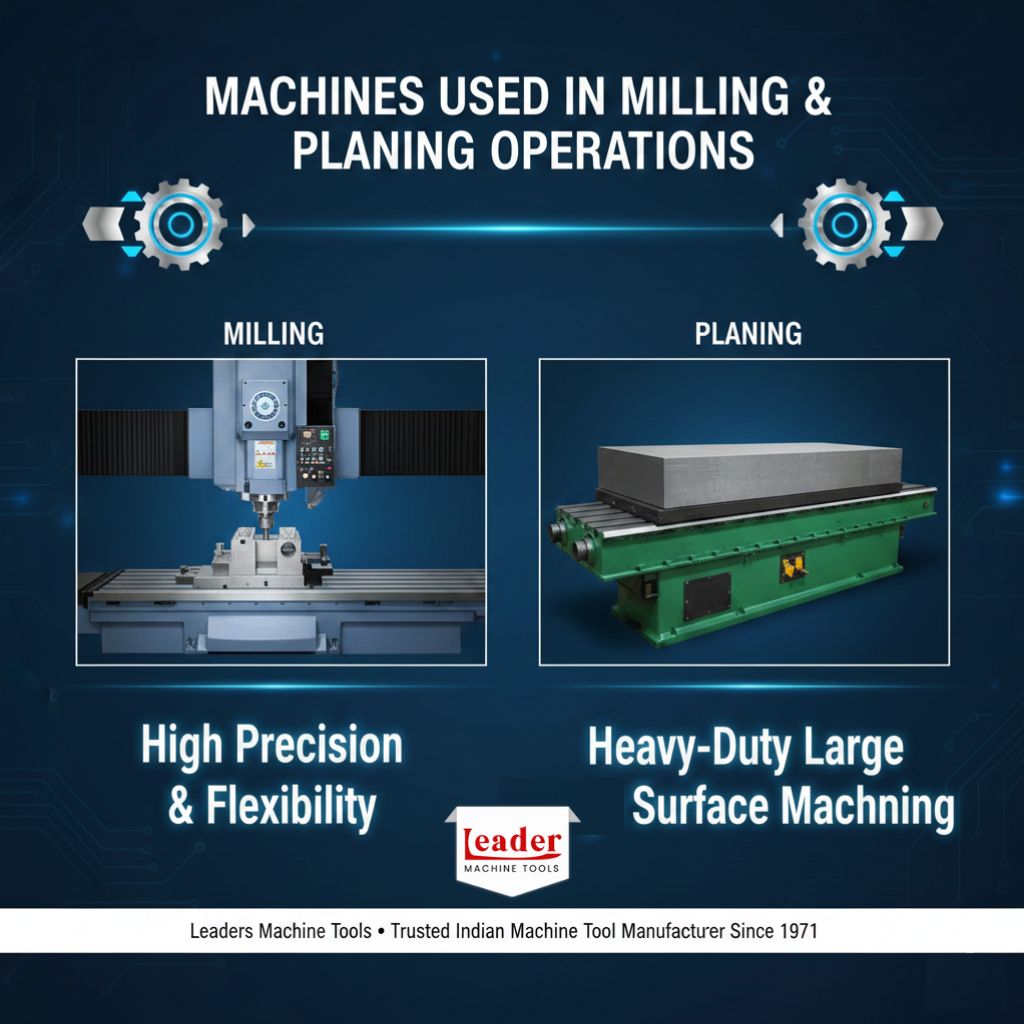
Common milling machines used in Indian industries include:
- Vertical Milling Machines
- Horizontal Milling Machines
- Universal Milling Machines
- Plano Milling Machines
- Turret Milling Machines
- Heavy-Duty Milling Machines for Workshops
At Leaders Machine Tools, we manufacture robust and accurate milling machines known for:
- In-house casting and heavy-grade material
- Precision-machined components
- Smooth feed mechanisms
- Long operational life
- Reliable after-sales support
Machines Used for Planing
Planing operations use the following machines:
- Heavy-Duty Planer Machine
- Double Column Planer
- Plano Miller (for hybrid milling+planing operations)
These machines are large, floor-mounted, and designed for heavy, oversized workpieces.
Conclusion
Both milling and planing are important machining processes, but they serve different purposes. Milling offers high accuracy and flexibility, while planing is still the best choice for large, heavy components.
With over 50 years of manufacturing experience, Leaders Machine Tools continues to support Indian industries with trusted machine tool solutions built for long life, consistent accuracy, and smooth performance.
CTA: See Our Milling and Planer Machines
Explore our high-quality Milling and Planer Machines designed for heavy-duty Indian workshops.
Contact Leaders Machine Tools today for expert guidance and reliable machine solutions.