Choosing the Right VTL Machine Size for Your Plant
leadermachinetools on 16 February, 2026 | No Comments
Selecting the right Vertical Turning Lathe (VTL) is one of the most important decisions for any machining facility dealing with valves, pump casings, heavy engineering parts, or large industrial components. An oversized machine increases cost, power consumption, and floor-space requirements—while an undersized machine limits the work you can take on.
With more than five decades of engineering excellence, Leaders Machine Tools, founded in 1971 by Sh. Darshan Lal Sehdev, has supported thousands of workshops across India in choosing the correct VTL configuration. From starting as a gunmetal casting unit to becoming a trusted manufacturer of lathes, milling machines, and custom VTLs, the company continues to be recognised for reliability and craftsmanship. The legacy also includes the prestigious Udyog Patra Award (1980), highlighting the brand’s commitment to Indian manufacturing.
This guide will help you understand which VTL size suits your plant and how to evaluate the essential parameters before finalising your machine.
Understanding Table Diameter and Height
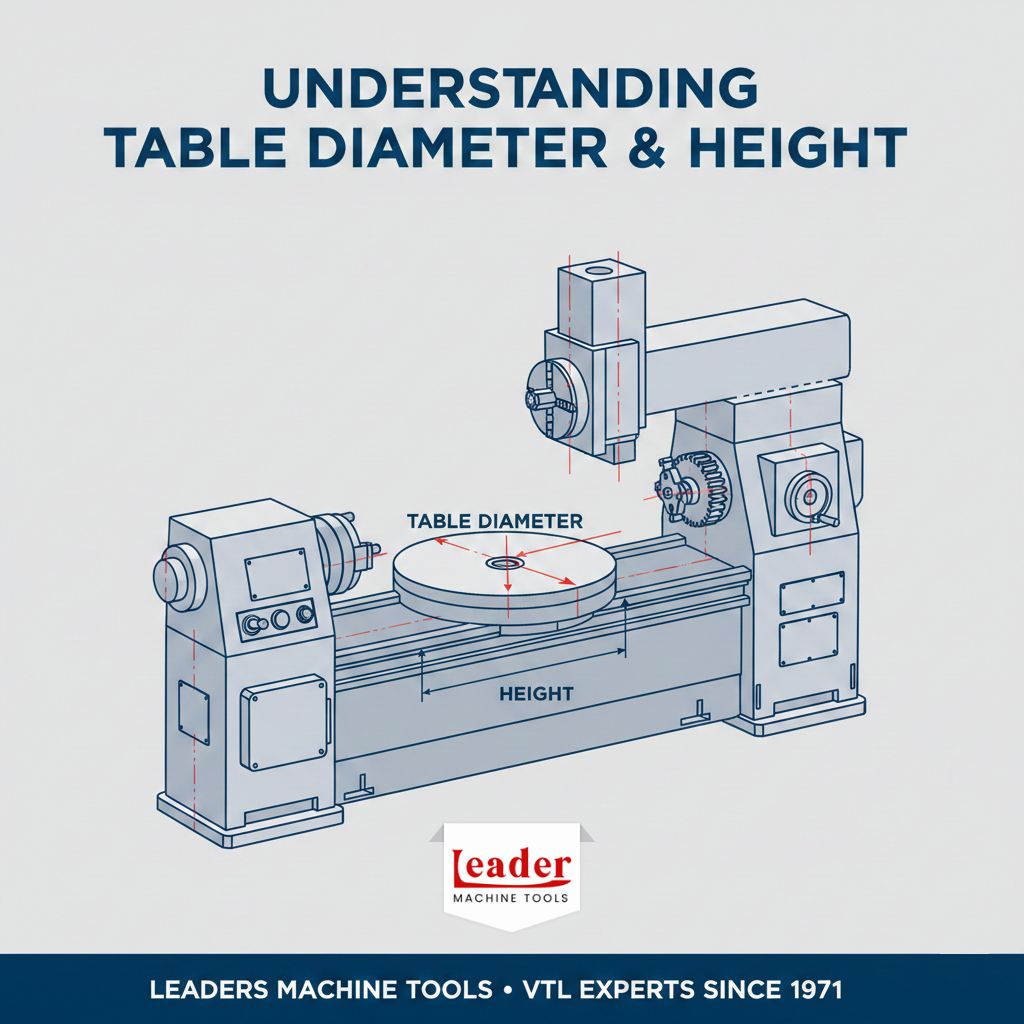
The table diameter is the starting point for choosing the correct VTL. It decides what size components you can comfortably machine.
1. Match Table Diameter to Workpiece OD
- For valves, pump bodies, gear rings, or flanges, always check the maximum outer diameter (OD) of your components.
- Choose a table size that offers at least 15–20% extra clearance for safe fixturing.
- Common industry ranges:
- Small VTLs (800–1200 mm table): Ideal for automotive parts, compact pump casings, smaller industrial fittings.
- Medium VTLs (1300–1800 mm table): Suitable for general engineering, valve industries, medium pump bodies.
- Large VTLs (2000 mm+ table): Best for heavy castings, large rings, defence components, and oversize industrial parts.
2. Height (Swing) and Vertical Travel
The height capacity defines whether tall components can be clamped and machined without repositioning.
When evaluating height:
- Consider the maximum part height + tool clearance.
- Taller components like deep pump volutes or long cylindrical housings need higher Z-axis travel.
- If you plan to expand your product range, choose an extra 50–100 mm to avoid future limitations.
Leaders Machine Tools designs VTLs with optimized height-to-diameter ratios, ensuring rigidity even at large swing capacities.
Weight & Capacity Considerations
Workpiece weight directly affects the machine’s structural integrity and long-term accuracy.
1. Check Table Load Capacity
Heavy castings require a VTL designed with:
- A robust table
- Large taper roller bearings
- Properly machined seating
- Well-balanced drive and clamping systems
If the load exceeds your table’s rated capacity, it may damage:
- Spindle bearings
- Table balancing
- Guideways
- Long-term accuracy
Leaders Machine Tools ensures each VTL table is balanced, supported, and stress-relieved to handle continuous heavy-duty operation.
2. Evaluate the Base, Column, and Ram Strength
For industries handling defence components or large pump casings, the machine must withstand:
- High cutting forces
- Interrupted cuts
- Off-center loads
Our machines use rigid casting structures produced in-house, ensuring stability and vibration-free performance for decades.
Power and Speed Requirements

The spindle motor and speed range decide what materials you can cut and how efficiently.
1. Power (kW)
- Higher power is needed for stainless steel, alloy steel, duplex, and hardened castings.
- Moderate power is suitable for CI castings, mild steel, and general engineering parts.
For example:
- Small VTLs: 7.5–15 kW
- Medium VTLs: 20–30 kW
- Large VTLs: 35 kW+
Leaders Machine Tools offers custom spindle power configurations depending on your production requirements.
2. Speed Range
A wider speed range gives better flexibility:
- Low RPM for large diameters
- Higher RPM for smaller precision components
This is especially useful in industries machining a mix of parts.
Choosing Between Single Column and Double Column
Both designs have their own advantages, and the right choice depends on accuracy requirements, part size, and load distribution.
Single Column VTL
Best for:
- Small and medium components
- Moderate loads
- Short-height parts
Benefits:
- Compact footprint
- Faster movement
- Cost-effective for job shops and general machining units
Double Column (DC) VTL
Best for:
- Heavy engineering and defence sectors
- Large diameter castings
- High cutting force applications
Benefits:
- Exceptional rigidity
- Even load distribution
- Higher accuracy for heavy-duty applications
- Better long-term repeatability
Leaders Machine Tools manufactures both single-column and double-column VTLs, giving plant owners flexibility based on their shop floor needs.
Tips for Long-Term Reliability

A VTL is a long-term investment—many machines operate for 25+ years when designed and maintained properly. Here’s what to look for:
1. Stress-Relieved Castings
Machines built with stress-relieved grade cast iron maintain accuracy longer.
We use in-house manufactured castings with controlled cooling to reduce internal stress.
2. Precision Guideways
Hardened, ground, and properly lubricated guideways ensure smooth movement and high tool life.
3. Quality Electricals & CNC Systems
Always choose branded components for:
- Drives
- Motors
- Servo systems
- CNC controllers
This reduces downtime and simplifies maintenance.
4. Availability of Customisation
Every plant has unique production needs.
Leaders Machine Tools is known for offering:
- Tailor-made table sizes
- Special height requirements
- Custom fixturing
- Optional enclosures
- Automation and CNC retrofits
5. After-Sales Support
A reliable service team ensures your machine keeps running with minimal stoppage.
With decades of experience and a strong dealer network, Leaders Machine Tools is committed to lifetime service support.
Conclusion
Choosing the right VTL machine size is not just a technical decision — it directly impacts productivity, machining capability, and your plant’s future growth. Whether you manufacture valves, pump casings, heavy engineering parts, or defence components, evaluating table size, height, load capacity, power, and design structure will help you make an informed choice.
With a legacy dating back to 1971 and a reputation built on trust, craftsmanship, and engineering excellence, Leaders Machine Tools is well-positioned to guide you in selecting the ideal VTL for your operations.
CTA
Consult with Leaders Machine Tools engineers for personalised VTL size recommendations based on your components and production requirements.